

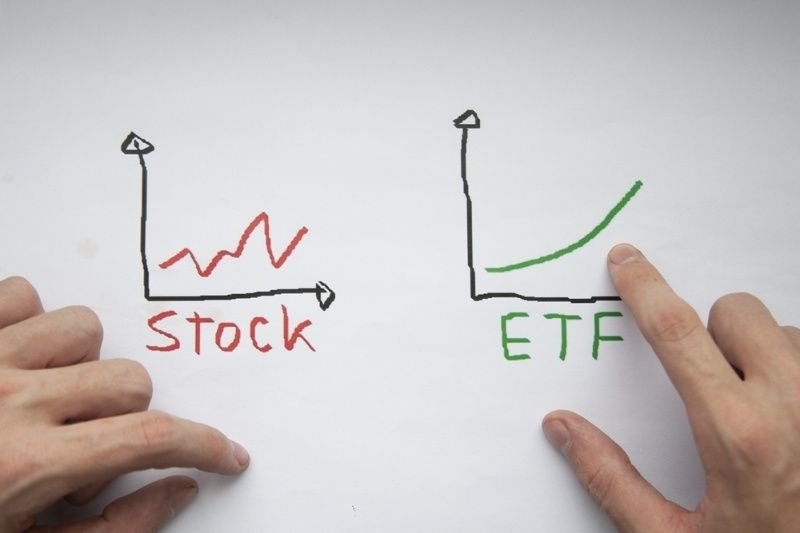
Long-term wealth accumulation can benefit stock and ETN buying. Mix can offer good diversification of stocks and ETFs in one portfolio. Deciding about investments can be overwhelming, and if you are a beginner, it is likely you will end up considering buying stocks vs. ETFs, one type of typical option available to investors to participate in the stock market with distinct variations from their counterparts, which would eventually compare stocks vs ETFs.
Understanding the stock vs ETFs investment world is the first step towards the choice between the two. Both are traded on the stock market, yet they're not of the same kind.
Stocks mean ownership in one company. As the share purchaser, if the enterprise does well, your investment will be a fortune based on the success of the company, its profits, and future progress. If the company is doing well, then investors' capital will be increased in the form of rising stock prices and dividends.
An ETF, or exchange-traded fund, is a group of investments—stocks, bonds, or other assets. When investors use ETFs, instead of putting their capital into one company, they put it into a fund that covers several companies. As a result, ETF investing is very popular.
An investment in stocks means an investment in actual companies with potential for profit for the buyer. Investors typically buy shares in those they expect to increase, or stocks in which they would prefer to have equity.
Advantages of purchasing stocks are:
However, stocks tend to be riskier on a per-stock basis. If the company you put your money in sells off, the share price may fall below zero. Stock investing also takes some time to invest in studying company financial statements and to understand the risk.
When contrasted with ETF investing, stocks generally involve a greater investment of time and effort in terms of research and the active choices made.
Learn More: 4 Bond Basics Every Smart Investor Must Understand
ETF investing has become popular because it can be very simple and can also provide diversification. When investing in a fund, instead of buying a number of individual stocks, you can purchase an ETF that will contain a number of businesses or an index of the market.
Some benefits of ETF investing include:
For novice investors, exchange-traded funds can be an effective way of investing in the stock market without having to analyze each company individually.
The most significant benefit of ETFs is that an investment can contain multiple holdings. Instead of depending on the performance of one stock, you can spread it over many stocks. It also makes it easier to invest.
The key differences between stocks and ETFs are great for investors to distinguish which one is more suitable for them.
| Feature | Stocks | ETFs |
|---|---|---|
| Investment Type | Individual company shares | Collection of assets |
| Risk Level | Higher company-specific risk | Lower due to diversification |
| Research Needed | More detailed analysis | Less individual research |
| Control | More control over selections | Fund manager controls holdings |
| Suitable For | Active investors | Long-term and beginner investors |
The main differences above show why each investment seems to suit different investors. Investors who like to do their research might prefer stocks, whereas ETF investors could prefer a simpler strategy.
Figuring out how to pick between stocks vs ETF investing can be daunting for new investors. New investors typically go with ETFs because they can offer instant diversification and mitigate the effect of one poorly performing company. ETF investing is not as hands-off as Buy and Hold; ETF investors can build a portfolio but without selecting dozens of individual stocks. This approach still allows exposure to the market and may be "easier" to learn.
Yet, individual stocks may attract investors who like to analyze businesses and are willing to take more risk. Gaining knowledge about companies, industries, and financial markets can be useful in stock market investing. This is entirely personal. It's a matter of how much experience you've got, how soon you want to see investment results, and how comfortable you are with volatility.
Most investors, however, will not always settle for just one. Perhaps a mixture of stocks and ETFs might offer diversification as well as growth potential.
For instance, an investor may include broad-market ETFS as the core of his portfolio with stock additions for further growth. Meanwhile, the broad-market ETFs provide some protection during downturns.
Knowing the difference between stocks and ETFs does not have to lead to one or the other taking over from the other. The two can work together to reach your financial goals in the future.
To decide which is the best, it really depends on one's own purpose and the style of one's own investment. If you would like to learn about energy and want a stronger controlling mode, then stocks are better. However, if you would like to find a simpler way with broader diversification, ETFs are more appropriate.
Also, before you invest, take into account the level of risk you are prepared to take, the period of time over which you would like to invest, and your financial goals. A well-researched strategy when investing in the stock market can prevent you from making rash decisions that can adversely affect your investment portfolio.
Other than you control most of what you can buy and how much, it matters whether you buy stocks, ETF's, or both this way. To get a guiding hand, check out ETF investing and the major distinctions between the options.
Overall, whether you should invest in stocks or ETFs depends on what you want to achieve and how well-informed you are about investing. If you want higher gains, stocks will be the better choice; if, however, you want diversification and a buy-and-hold-based investment, ETFs will be preferable. Knowing the main differences enables investors to form an approach that enables them to successfully invest in the stock market.
Whether you choose to invest in stocks or ETFs, along with learning to manage risk, both are powerful tools for building long-term wealth.
ETFs are usually considered a more conservative investment than stocks because they hold more than one stock. Thus, they are less dependent on the success of a single company's stock, and if one company's stock doesn't do well, others holding up the group will usually support the fund. If there's a crash in the market, ETFs can lose money—just make sure that ETFs come within the range that you consider you can accept.
Yes, you can begin by taking your time and, with a small sum, by buying a fraction of a stock or ETF through various platforms. Stocks and ETFs both represent viable options depending on the stock holding and investment platform. Getting a good start and continuing to invest would really assist you in gaining experience and growing healthy financial habits.
ETFs do not always come out as making better returns than stocks; for some, a single stock might do exceptionally better. ETFs will endeavor to grow your money through diversification. Whether to invest in an ETF or individual stocks will hinge on the particular investor's intentions, capacity for research, and ability to manage the investment risk level.
Most stocks and ETFs tend to have investments held for years for the benefit of sustained market returns; stock or ETF returns can only grow with time. Short-term increases or losses can, and will, be variable, but a sustained term can lead to greater rewards.
This content was created by AI